
August 2, 2026 · 7 views
How to Say “I’m in a Food Coma” in Korean? 😴
Hello!
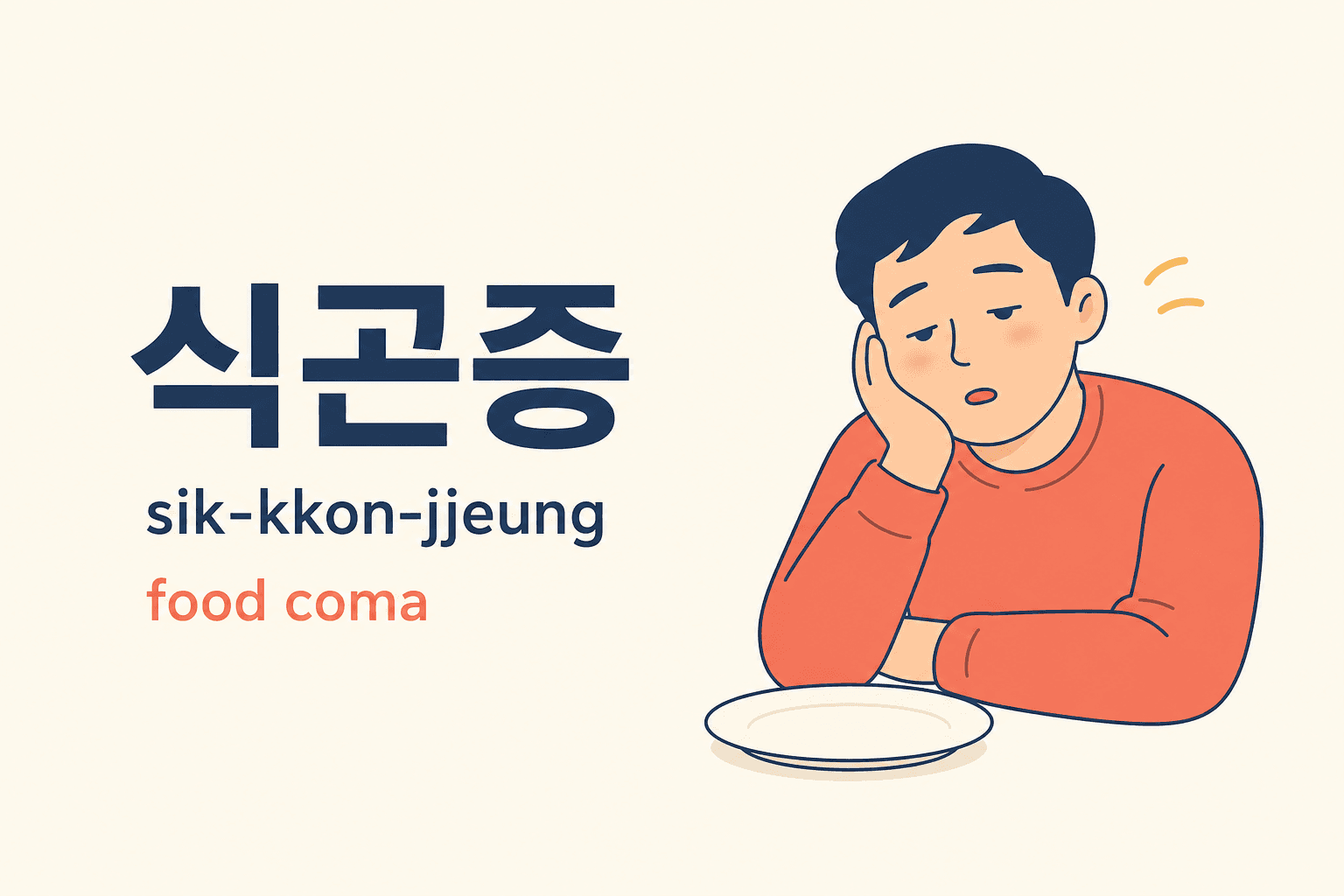
Do you ever feel overwhelmingly sleepy after a meal? In Korean, this post-meal drowsiness is called 식곤증 (sik-kkon-jjeung).
What Does 식곤증 Mean?
식곤증 refers to the tired, sluggish feeling that comes after eating. It is similar to the casual English expression “food coma,” although 식곤증 itself is a standard Korean noun rather than playful slang.
The word is made from three Sino-Korean parts:
식 (食) — food or eating
곤 (困) — tiredness or difficulty
증 (症) — condition or symptom
Here are two natural ways to talk about it.
1. Saying You Have 식곤증
Korean: 식곤증 왔어.
Pronunciation: sik-kkon-jjeung wa-sseo.
Meaning: I’m in a food coma. / I’ve got post-meal drowsiness.
2. Using a More Everyday Sentence 🥱
Korean: 밥 먹고 나니까 너무 졸려.
Pronunciation: bam meok-kko na-ni-kka neo-mu jol-lyeo.
Meaning: I’m so sleepy now that I’ve eaten.
If you want to describe the feeling without using the noun 식곤증, this everyday sentence is also natural. 밥 먹고 나니까 means “now that I’ve eaten,” while 너무 졸려 means “I’m so sleepy.”
💡 Quick Usage Tip
식곤증 왔어 (sik-kkon-jjeung wa-sseo) — casual
식곤증이 왔어요 (sik-kkon-jjeung-i wa-sseo-yo) — polite
🎯 Takeaway of the Day
식곤증 왔어! (sik-kkon-jjeung wa-sseo!)
Use it when sleepiness and low energy hit you after a meal.
One expression a day, make it yours.
하루에 한 표현을 내 것으로!
Written by ktalk.today